68 dead as Spanish high-speed rail suffers second fatal crash in a year
A collision in Toledo province occurred four weeks before national elections, prompting the government to declare a three-day period of national mourning.
By Eric Laurent ·
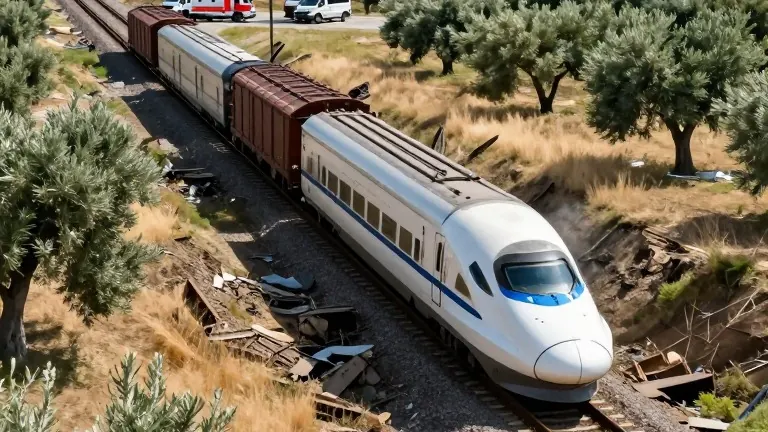
The death toll from a high-speed rail collision in central Spain rose to 68 on Wednesday, marking the second fatal accident on the network within twelve months. Regional authorities in Toledo province confirmed that more than 60 individuals were dead, with dozens of others receiving treatment at local hospitals. The incident occurred on a rural stretch of track lined with olive groves, where one train struck a stationary vehicle from behind.
Prime Minister Pedro Sánchez visited the crash site in the town of Urda to assess the damage. He stated that the government must reinforce safety protocols to restore public confidence in the rail system. Sánchez noted that it is unacceptable for a country of Spain's size to experience two major high-speed rail accidents in a single year. His administration declared three days of national mourning beginning Thursday to honor the victims.
Spain's high-speed rail network has long been viewed as a national achievement, ranking second in the world in total track mileage behind only China. Until this year, the system had not recorded a deadly crash since it began operations more than three decades ago. The network carried 45 million travelers in the previous year, a figure that included millions of tourists. The recent accidents have shaken faith in the infrastructure that connects the country's major cities.
The political timing of the disaster has intensified scrutiny on Sánchez's leadership ahead of the national election scheduled for four weeks from now. Polls indicate that his Socialist party faces a challenging campaign against conservative rivals. Sánchez had previously called for early elections, hoping to capitalize on voter dissatisfaction regarding housing costs and high rents. He posted a message on social media about an hour before the crash, stating that there were many reasons to be optimistic about the country.
Both fatal incidents this year involved a train operated by the state-owned RENFE and a train from the privately owned IRYO. Spain liberalized its high-speed rail market in 2021, and the Italian carrier IRYO began service the following year. This shift allowed private operators to compete with the state monopoly, a change that has now been tested by two consecutive disasters.
Transport Minister Óscar Puente addressed the media regarding the cause of the collision. He identified a computer malfunction as the root cause, which disabled the security system on a 63 kilometer stretch of track at 8:30 a.m. This failure forced all trains in the area to stop. The IRYO train halted near Urda, while a RENFE train stopped 25 kilometers behind it. Minutes later, central command instructed the RENFE train to resume movement without speed restrictions, despite an active stop signal on the line. The moving train collided with the stationary IRYO train at 8:53 a.m.
Puente stated that the train engineers were not at fault for the accident. He argued that the central command should not have authorized the restart, or should have imposed reduced speeds. The minister said he was fully focused on managing the collision response rather than considering his political future, though questions arose about whether he would resign after the second major wreck under his tenure.
Political rivals reacted quickly to the news. Alberto Núñez Feijóo, the leader of the conservative Popular Party, demanded a full investigation into the crash. He announced that his party would cancel its campaign events for the day to respect the victims. Feijóo said that Spaniards are asking tough questions that require answers from the government. Santiago Abascal, the leader of the far-right Vox party, used more forceful language, describing the government as a criminal organization that must answer for its actions in court.
Emergency workers, firefighters, police, and soldiers worked throughout Wednesday to rescue survivors and recover bodies. Cranes began moving parts of the damaged trains late in the day after the initial rescue efforts concluded. The scene of the accident remained active as authorities continued to assess the structural integrity of the derailed cars.
Source: KGOU