Sorbonne Model Solves Mystery of 1,000-Mile Mars Cloud
Researchers attribute the formation of the Arsia Mons Elongated Cloud to a rare physical process requiring a 30-degree temperature drop in ten minutes.
By Eric Laurent ·
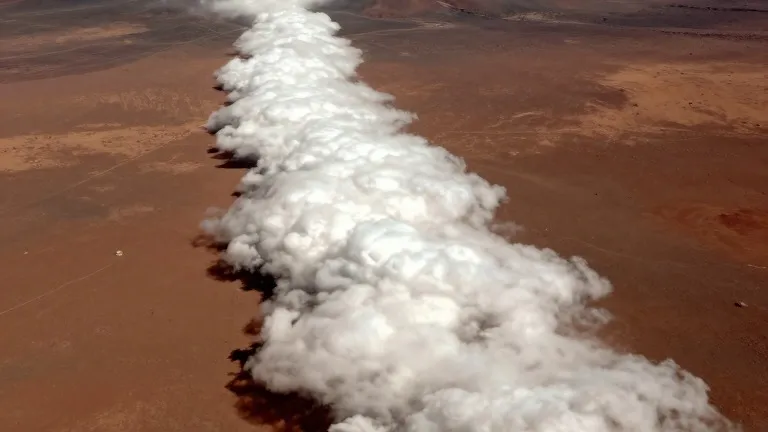
100,000 times the humidity levels found on Earth appear necessary to form a specific Martian cloud. A new study published in Nature Geoscience offers a potential explanation for the Arsia Mons Elongated Cloud, or AMEC, a feature that stretches over 1,000 miles. The modeling work suggests the cloud forms through a mechanism rarely seen in planetary atmospheres.
The AMEC appears during Martian spring and summer. It begins as a small feature and grows until it spans a distance comparable to the stretch between New York and Kansas City. The cloud then dissipates by the end of the morning. This cycle has repeated for several months each year since a probe first recorded the phenomenon in 2018.
Jorge Hernández-Bernal, a planetary scientist at Sorbonne Université, led the research team. He stated that standard cloud formation models failed to reproduce the AMEC. The team introduced what Hernández-Bernal described as exotic physics to their simulations. This refers to homogeneous nucleation, a process where water vapor turns directly into ice crystals without needing dust or salt particles to act as seeds.
Hernández-Bernal noted that this physics is present in textbooks but is often treated as theoretical. He compared the process to condensation appearing in the middle of a room rather than on a window surface. Once the researchers included this mechanism, the model successfully generated the cloud. He called the result wholly unexpected.
The formation process requires extreme conditions. The air must cool by 30 degrees Celsius within ten minutes while maintaining high relative humidity. The 65,000-foot Arsia Mons volcano plays a central role in creating these conditions. As wind hits the volcano, it generates a powerful wave that lifts moist air high into the atmosphere rapidly.
Scientists have long suspected homogeneous nucleation could occur in the upper atmospheres of planets like Venus and Earth. However, no direct observation has confirmed this process in nature. The extreme humidity required on Mars may explain why it has remained undetected elsewhere. Hernández-Bernal added that much less is known about the Martian atmosphere than about Earth's, making the successful reproduction of the cloud a notable achievement.
The study resolves a puzzle that has persisted since the initial 2018 discovery. Previous attempts to explain the AMEC lacked a plausible mechanism for its rapid growth and disappearance. The new model accounts for the specific timing and size of the cloud. The findings suggest that rare physical processes may be shaping weather on other planets in ways previously assumed impossible.
Source: Wired